
This week in class, we discussed Patricia Bizzell’s article “What is a Discourse Community?” and as I was listening to the discussion, I was thinking about a research project I completed in the spring of last year.

Bizzell defines a “discourse community” as “a group of people who share certain language-using practices” (222). While the use of distinct language is critical to defining a discourse community, there are other more subtle ways that a community can manifest. John Swales has created a list of criteria that a group must meet to be considered a discourse community (225-226):
- A common “goal”
- A “forum” accessible to all members
- Members provide feedback and information on the forum
- Shared discourse conventions or “genres”
- Shared, specialized language
- Experts and novices
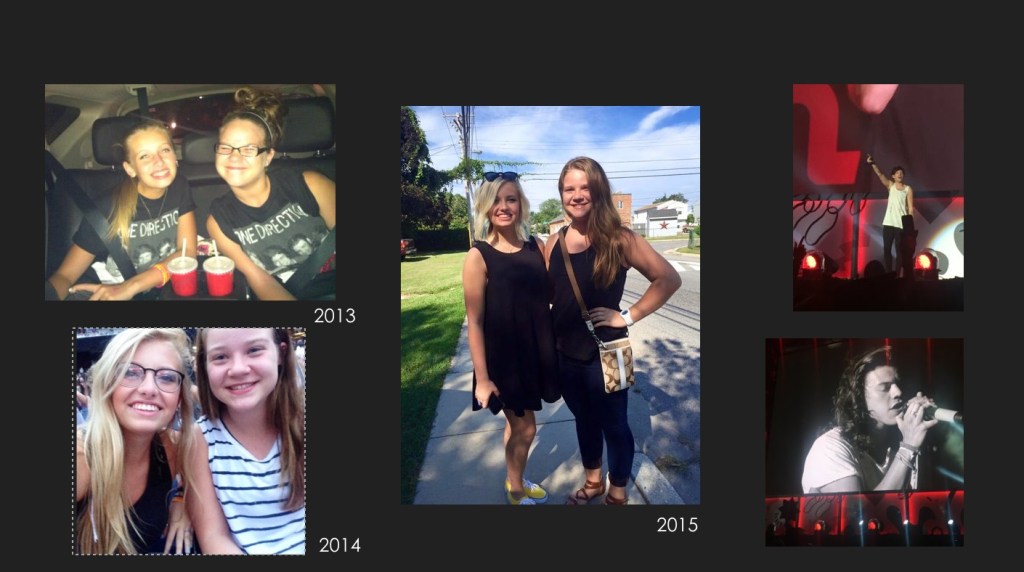
In my research assignment for Advanced Composition, I analyzed the One Direction fandom and the way in which its members formed a discourse community through the creation of their online identities. As a former member of the fandom, I have an in-depth knowledge of the conventions, language, and places fans congregate.
In the following diagram, I adapted the activity we did in class with a discourse community we belong to and input the appropriate data for the One Direction fandom.
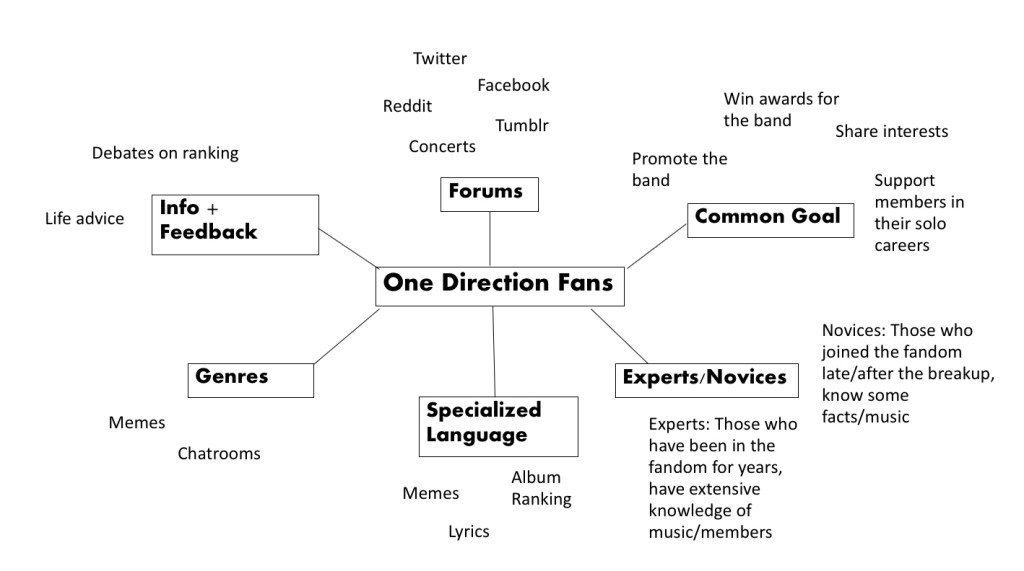
The most interesting part of the fandom is that it has held up years after the separation of the band. Even after declaring a “hiatus,” the fans continue to win awards for the band as well as the boys in their solo careers. The Reddit, Twitter, and Instagram stay active with those looking to discuss memories and theories of the band’s return.
I believe the fandom meets Bizzell and Swales’ criteria to be a discourse community because of the multiple “forums” fans can speak on, the specialized language they use, and the common goal of maintaining the band’s legacy even after separation.
 Brianna Price